Playing Tips
August 23, 2026 · 7 min read · by Bob Molton
Why Your Barre Chords Buzz (and How to Fix Them)
Barre chords buzz because of a handful of specific, fixable problems — thumb position, finger placement, guitar setup, or simply asking your hand to do too much at once — and almost never because you lack the strength for it. Find which one is yours and the buzz usually disappears within a week or two of focused practice.
Before you shop
Get the free 7-point buyer's checklist
The exact checks I run on every guitar before I buy it. One page, five minutes, no cost.
No spam, no daily blasts. Unsubscribe any time.
Why does the F chord feel like a wall?
I have taught this exact frustration probably a thousand times. A student gets through open chords just fine, feels good about themselves, and then the method book puts an F chord in front of them and it all falls apart.
The strings buzz, the notes go dead, their hand starts shaking, and within about ninety seconds they've decided they simply don't have the hands for barre chords. That belief is almost never true.
Barre chords ask your first finger to do the job that four fingers usually share on an open chord — press six strings flat against a fret with even pressure. That's a genuinely different skill than anything you built on open chords, which is exactly why it doesn't come free just because you're 'getting better' in general.
The good news is that buzzing barre chords are a diagnosis problem, not a talent problem. Let's find out which piece is actually broken for you.
Is your thumb in the wrong spot?
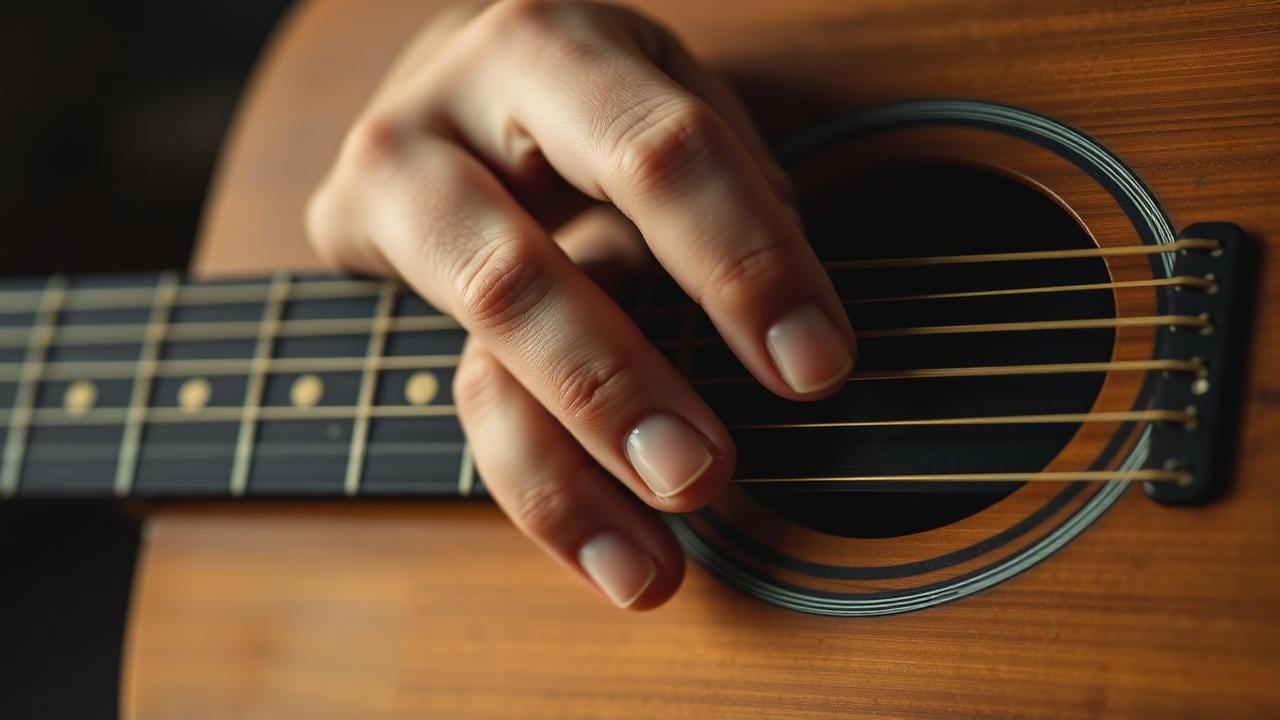
Check your thumb before you check anything else. It should sit on the back of the neck, roughly behind your first or second finger, pointing up toward the ceiling rather than wrapping over the top like you're gripping a baseball bat.
A thumb that's too high, wrapped over the top, makes it almost physically impossible to get your first finger flat and firm across all six strings. It's fighting your barre before your barre even starts.
Try this: press the pad of your thumb straight into the back of the neck, like you're pressing a doorbell, roughly opposite your first finger. Squeeze gently between thumb and first finger rather than mashing down from above. That squeeze does most of the work, not brute downward force from your wrist.
This one change fixes more barre chords than any amount of extra practice time, because it changes the mechanics instead of just adding more strength on top of bad mechanics.
Is your finger in the wrong spot on the fret?
Move your barring finger right up against the fret wire, not in the middle of the space between frets. A half-inch back from the fret and you'll need twice the pressure to get a clean note, every single time.
Also check the angle of your first finger. A lot of players lay it down completely flat, which sounds logical but actually reduces pressure right where you need it most — under the knuckle bones, where the finger is bonier and firmer.
Try rolling your first finger very slightly toward its outer edge, the side closest to your thumbnail. That edge is firmer than the fleshy pad, and a lot of players get an instant improvement in clarity just from that small rotation.
One string almost always causes the trouble — usually the high E or the B string, wherever your finger's natural curve leaves a slight gap. Play the barre alone, no other fingers added yet, and pluck each string one at a time until you find your weak string. Now you know exactly what to fix instead of guessing.
Could your guitar actually be the problem?
Sometimes it isn't you at all. If open chords ring clean but barre chords buzz everywhere no matter what you try, your guitar's action might genuinely be too high or too low for comfortable barring.
High action means every fret needs more pressure than it should, which tires your hand out before your technique even gets a fair test. Low action with poor neck relief can cause buzzing that no amount of finger strength will ever fix, because the string is hitting a fret further up the neck.
A proper setup — checking the neck relief, the nut slots and the action at the twelfth fret — costs less than a pair of decent strings and can turn a guitar that fights every barre chord into one that cooperates. I'd rather see a student spend $70 on a setup than another two months blaming their hands.
If you're not sure whether it's you or the guitar, try the same barre chord on a friend's guitar or one at a shop. If it suddenly feels easy, you've found your answer.
How should you actually practice this?
Stop practicing full barre chords for a few days and practice just the barre by itself. Lay your first finger across all six strings at the first fret, check each string rings clean, release, rest, and do it again.
This isolates the one muscle pattern that's actually new, instead of asking your hand to learn barring and finger placement and chord changes all at the same moment. Ten focused minutes of this beats thirty minutes of frustrated full chords.
Once the bare barre rings clean, add just your third finger for a power chord shape, then build up to the full F chord. Each added finger should feel like a small addition to something that already works, not a fresh struggle.
Rest matters more than people think here. Barring uses a static muscle contraction, which fatigues fast. Play the shape, check it, release your hand completely for a few seconds, and go again. Fighting through fatigue trains bad habits, not good ones.
What if it still buzzes after a week of this?
Give it real time before you get discouraged. Most players see genuine improvement within one to two weeks of daily short sessions, but full comfort with barre chords usually takes four to eight weeks of consistent practice, not days.
If you're doing everything above correctly and still fighting it after several weeks, that's usually a sign either your guitar needs attention or your practice sessions are too long and fatigue is masking real progress.
Try filming your hand from the side with your phone. Watching your own thumb and finger angle on video catches habits you can't feel while you're focused on the sound.
And don't skip straight to barre chords up the neck. The first-fret F is genuinely one of the hardest because the frets are widest there. Barre chords higher up the neck, where frets sit closer together, are often noticeably easier — a nice confidence boost while your low barre keeps improving.
Are there shortcuts while you build the strength?
Yes, and I use them with beginners all the time. Capo-based versions of songs let you play open-chord shapes while still learning real songs, buying you time while your barre chord technique develops in the background.
There are also simplified barre shapes — using just your first and third fingers for a mini barre chord — that sound close enough for most songs while you're building toward the full six-string version.
None of these are cheating. They're how working musicians actually manage a neck full of chord shapes, and they keep you playing real music instead of grinding on one exercise until you burn out on it.
The goal isn't to avoid barre chords forever — it's to keep enjoying the guitar while the specific muscle pattern catches up to the rest of your playing.
What's the single biggest mindset shift here?
Stop treating buzz as a verdict on your talent and start treating it as information. Every buzz is your hand or your guitar telling you exactly what to adjust next.
The players who get past this fastest are the ones who get curious about the buzz instead of frustrated by it. Which string? Which finger position? Thumb high or low? That curiosity turns a wall into a checklist.
I've watched students go from despising the F chord to using it as their warm-up exercise, purely because they stopped fighting it in general and started fixing it specifically.
If you want a second set of eyes on your hand position, that's exactly the kind of small, fixable thing we work through together in lessons — usually it takes minutes to spot, once someone's actually watching.
FAQ
Questions people ask me
Keep in touch
One useful guitar email at a time
Join the list and I'll send the free checklist now, plus new tools and posts as they land.
No spam, no daily blasts. Unsubscribe any time.
Keep reading
Where to go next
- Lessons with Bob
One-to-one lessons where we watch your hand and fix the exact habit that's buzzing.
- Get the free guide
Practical starting points for building technique that actually sticks.
- Run the Guitar Matcher
See whether your guitar's neck and action are working against your barre chords.