Guitar Life
August 8, 2026 · 7 min read · by Bob Molton
Playing Guitar in a Busy Life: Finding Fifteen Minutes
Practicing guitar on a busy schedule works when you stop waiting for a free hour that never comes and start using fifteen honest minutes wherever they hide in your day. Short, frequent sessions build real skill faster than the occasional marathon practice you keep telling yourself you'll get to eventually.
Before you shop
Get the free 7-point buyer's checklist
The exact checks I run on every guitar before I buy it. One page, five minutes, no cost.
No spam, no daily blasts. Unsubscribe any time.
Why does 'I'll practice when I have more time' never actually happen?
I hear this from students constantly, and I said it to myself for years before I actually became a decent player. "Once things calm down, I'll really dig into practicing."
Things don't calm down. That's not pessimism, it's just how adult life works — a quiet week gets filled the moment it opens up, because that's what quiet weeks are for. Waiting for spaciousness before you commit to guitar means waiting indefinitely.
The players I know who actually improve steadily, year over year, despite full-time jobs and families and everything else, are not the ones with more free time. They're the ones who stopped needing an hour to feel like practice counted.
Fifteen minutes counts. It counts every single day it happens, and it beats a two-hour session that only happens once a month.
I used to feel almost guilty logging a short session, like it didn't really count as "real" practice. That guilt was the actual obstacle, not my schedule. Once I dropped it, the guitar came out far more often.
Why do fifteen-minute sessions actually work better than long ones?
Learning a physical skill like guitar depends heavily on repetition spread across time, not concentrated in one sitting. Your hands and your brain both need rest between sessions to actually encode what you practiced.
A single two-hour session mostly teaches your hands to be tired. A fifteen-minute session every day for two weeks teaches your hands the actual movement, with fourteen separate chances for your brain to consolidate it overnight. The daily version wins on total skill built, even though it's a fraction of the total time.
There's also a psychological advantage that matters just as much as the physiological one. Fifteen minutes feels achievable on a bad day. An hour feels like a project you'll postpone. Something you'll actually start beats something ideal that you keep deferring, every time.
I've had students track this for a month, comparing a string of short sessions against their old habit of one long weekend push. Almost every one of them was startled at how much more they retained doing less, more often.
How do you actually find fifteen minutes in a packed day?
Stop looking for a free block and start attaching guitar to something that already happens every day. Habits stick best when they ride alongside an existing routine instead of needing their own slot on the calendar.
Coffee brewing in the morning is about four minutes — enough for a warm-up. Waiting for dinner to finish cooking, waiting for a video call to start, the ten minutes after you put the kids to bed and before you're too tired to think — these pockets exist in almost everyone's day. You're just not currently noticing them because you've trained yourself to reach for your phone instead.
The trick is deciding in advance which pocket is yours, rather than hoping one appears. "I'll practice after dinner" is vague enough to evaporate. "I'll practice while the coffee brews" is specific enough to actually happen, because it's tied to something that happens whether you plan for it or not.
Write the pocket down somewhere you'll actually see it, even if it's just a sticky note on the coffee maker. The point isn't the note itself, it's forcing yourself to name one specific trigger instead of a vague good intention.
Does the guitar's location really change whether you play it?
Enormously, and this is the piece most busy players get wrong. A guitar in a case in a closet requires a decision every single time — open the closet, unlatch the case, find a pick. Each of those tiny steps is a chance to talk yourself out of it.
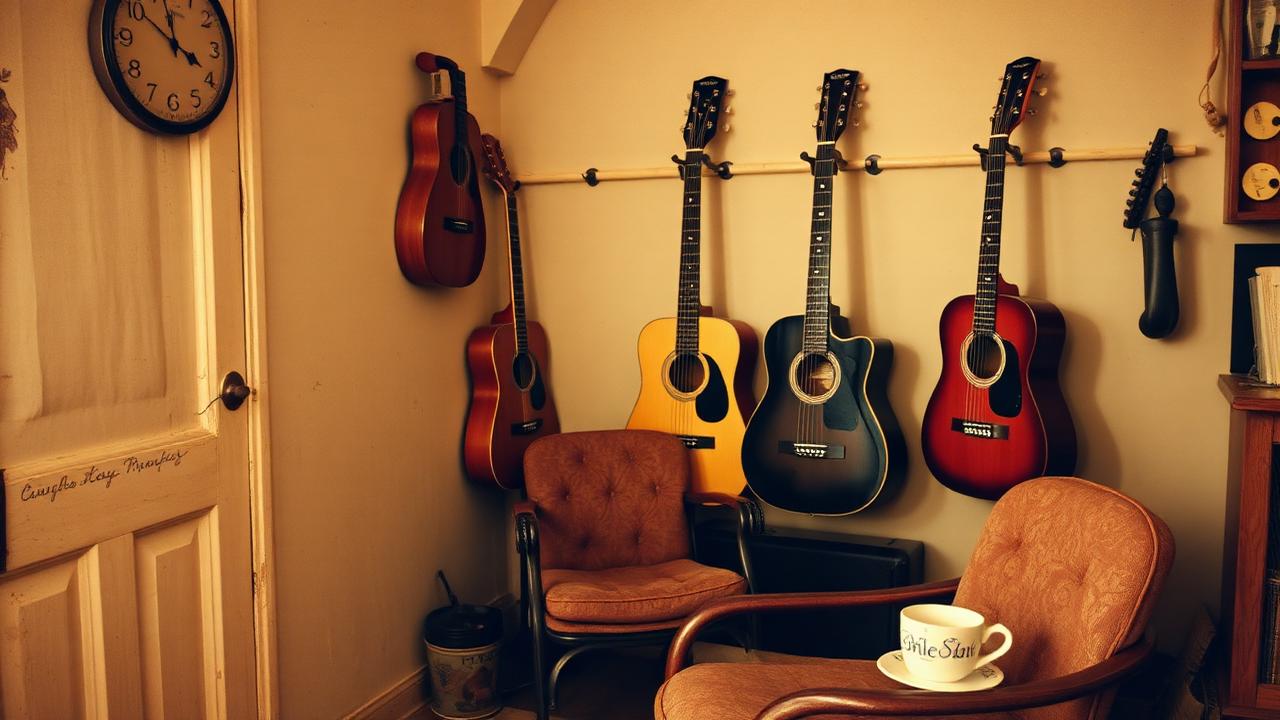
A guitar on a stand in the room where you actually spend your evenings requires no decision at all. You walk past it, you pick it up, you play for a few minutes, you set it back down. That's the entire mechanism behind consistent short practice — removing every possible point of friction between you and the instrument.
I tell every busy student the same thing: buy a twenty-dollar stand before you buy anything else. It will do more for your progress than a better guitar, a better amp, or a better practice app. Visibility beats intention every time.
The same logic applies to picks and a capo. Keep a small stash near the stand so a missing pick never becomes the excuse that talks you out of five minutes of playing.
Do you need a practice plan, or is noodling enough?
Some noodling is genuinely fine, especially on days you're worn out. It keeps the guitar part of your life without adding pressure.
But if every session turns into aimless noodling, you'll plateau, because nothing is actually being targeted. A little structure — even just naming one thing to work on before you sit down — makes a huge difference over months.
I tell students to keep it dead simple: one goal, written on a sticky note by the stand, changed weekly. That's enough structure to make fifteen minutes purposeful without turning it into homework.
What should you actually do with fifteen minutes?
Have a plan before you sit down, because deciding what to practice eats into the fifteen minutes you don't have to spare.
A simple rotation works well: one day on a chord change you're shaky on, one day on a scale or riff you're building speed with, one day just playing a song you love, badly if necessary. Rotate through those and you're covering technique, repertoire, and the plain enjoyment that keeps you coming back tomorrow.
Resist the urge to use short sessions only for warm-ups and "real" practice for the rare long session. If long sessions are rare, most of your actual growth needs to happen inside the short ones. Make them count on their own terms.
What if you miss a day, or a week?
It happens to everyone, including me. The mistake isn't missing a day — it's turning one missed day into a story about how you're "bad at keeping up with practice," which then becomes the reason you miss the next ten.
Just pick the guitar back up. There's no penalty for a gap other than the one you invent in your head. Skill built through short daily sessions is remarkably sticky; a week off costs you far less than you'd think, especially compared to how much a guilty conscience costs you in avoidance afterward.
If missed days are becoming a pattern rather than an occasional blip, that's usually a sign the guitar has drifted out of reach again, physically or mentally. Go back to the stand-in-the-living-room fix before you assume it's a discipline problem.
Is fifteen minutes a day really enough to get good?
It's enough to keep improving indefinitely, which is a different and better thing than "getting good" as some finish line. Fifteen focused minutes a day, most days, adds up to roughly ninety hours a year — more deliberate practice than a lot of hobbyist players log in three.
It won't make you a virtuoso by June. Nothing will. But it will make you a meaningfully better player by next year than you are today, and it will do it without asking you to reorganize a life that's already full. That trade is worth taking.
What if fifteen minutes still feels like too much some days?
Then do five. The goal on hard days isn't progress, it's not breaking the chain of showing up.
A five-minute session that's just picking up the guitar and playing something familiar still counts. It keeps the habit alive, and the habit is worth more long-term than any single day's output.
You can always build back up to fifteen once life eases slightly. What matters is that the guitar never becomes something you used to do.
FAQ
Questions people ask me
Keep in touch
One useful guitar email at a time
Join the list and I'll send the free checklist now, plus new tools and posts as they land.
No spam, no daily blasts. Unsubscribe any time.
Keep reading
Where to go next
- Lessons with Bob
One-to-one lessons designed around real, busy schedules, not ideal ones.
- Grab the free guide
A practical starting point for building a practice habit that actually sticks.
- Run the Guitar Matcher
Make sure the guitar itself isn't the reason you keep putting it down.