Choosing a Guitar
August 12, 2026 · 8 min read · by Bob Molton
Guitar Sizes Explained: Finding the Body and Neck That Fit You
Guitar sizes are about far more than looking right in photos — body depth, scale length and neck width all change how easily you can actually play the thing, and matching them to your frame is one of the biggest reasons some people stick with guitar and others quit.
Before you shop
Get the free 7-point buyer's checklist
The exact checks I run on every guitar before I buy it. One page, five minutes, no cost.
No spam, no daily blasts. Unsubscribe any time.
Why doesn't anyone explain guitar sizing up front?
I've watched shop staff hand a six-foot dreadnought to someone who's five-foot-two, and hand a delicate parlor guitar to someone with hands like a bear, purely because that's what was closest to the register.
Sizing gets treated like an afterthought, something you notice only after you've already bought the wrong one and started blaming yourself for the discomfort.
But guitar sizing isn't cosmetic. It's ergonomics. A guitar that's the wrong size for your body fights you every single time you pick it up, and that friction is exactly the kind of thing that quietly ends a beginner's habit.
So let's actually walk through what the sizes mean and how to read them like a tool instead of a mystery.
How do acoustic body sizes actually differ?
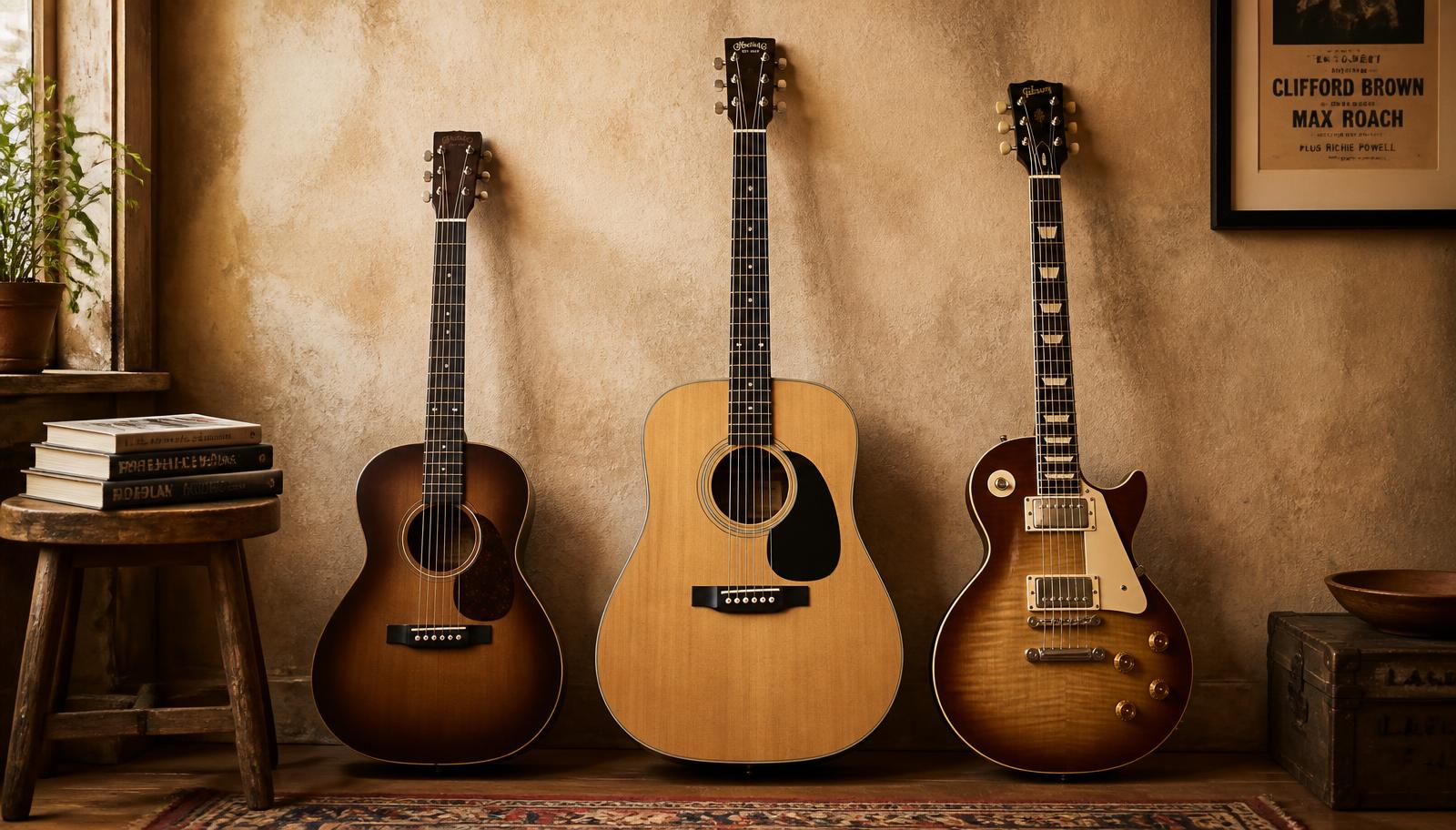
Acoustic bodies run roughly from smallest to largest: parlor, concert, grand concert, auditorium, dreadnought, and jumbo.
Parlor and concert bodies are compact and light, with a warm, focused tone. They're wonderful for smaller frames, for fingerstyle playing, and for anyone who finds a big body awkward to hug while sitting.
Dreadnoughts are the classic "guitar-shaped guitar" — deep, loud, boomy in the low end, and the standard choice for strumming singer-songwriters. They're also genuinely large, and reaching around one can pull your strumming shoulder forward if your torso is on the smaller side.
Jumbos sit even bigger than dreadnoughts, with a big low end that's fantastic on a stage and a bit much in a small bedroom. Auditorium and grand concert sizes split the difference — full-sounding but easier to wrap your arms around than a dreadnought.
None of these is objectively "the best" size. The best one is the one your body doesn't have to fight for twenty minutes at a stretch.
What does scale length actually change?
Scale length is the distance from the nut to the bridge, and it decides how far apart your frets are spaced. Longer scale, more stretch between frets. Shorter scale, tighter spacing.
A standard acoustic scale runs around 25.4 inches, and a standard Fender-style electric scale is similar at 25.5 inches. A Gibson-style electric scale drops to about 24.75 inches, which feels noticeably more compact under the fingers.
For players with smaller hands or shorter fingers, that shorter scale can be the difference between a chord that feels achievable and one that feels like a stretch every single time. It's a small number on a spec sheet that translates into a very real feeling in your hand.
Three-quarter-size and travel guitars go even shorter still, which is worth knowing if you're buying for a child or for someone who's found every full-size neck a struggle.
How does neck width and shape change the feel?
Neck width, measured at the nut, is usually somewhere between about 1.6 and 1.75 inches on acoustics, with classical guitars running wider still.
A narrower nut brings the strings closer together, which is friendlier for smaller hands but can feel cramped and prone to accidental muting for players with thicker fingers.
A wider nut spaces the strings out, giving big hands room to land cleanly on a chord, but it can feel like reaching across a highway if your hands are on the smaller side.
Neck shape matters too — a slim "C" profile feels sleek and modern, while a chunkier "U" or "V" profile fills the palm more and suits players who like something substantial to grip. There's no way to know which you prefer from a spec sheet alone. You have to hold it.
Do electric guitars need the same sizing thought?
Yes, though the variables shift slightly. Electric bodies vary less dramatically than acoustic bodies since there's no soundbox doing acoustic work, but weight and body contour still matter enormously over a long practice session.
A dense mahogany body can weigh noticeably more than a lightweight ash or alder one, and that difference shows up as shoulder fatigue after thirty minutes standing with a strap. If you plan to play standing, actually try the guitar on a strap in the shop before you buy — sitting comfort and standing comfort are not the same thing.
Neck profile and scale length carry over directly from what we just covered. A short-scale electric with a slim neck is often the single friendliest instrument I recommend to players with small or aching hands, regardless of the music they play.
How do you actually measure yourself for a guitar?
You don't need calipers. Sit in a normal chair, guitar in playing position, and check three things.
First, can your fretting hand wrap around the neck and reach the low E string with your thumb resting comfortably behind it, without your wrist bending at a sharp angle? Second, does the body's lower bout rest against your leg without you having to lean forward to reach the strings? Third, can your strumming arm rest over the top edge without your shoulder hiking up toward your ear?
If you answer no to any of those after five minutes of holding the instrument, that's real information, not something to push through out of stubbornness. Discomfort at the five-minute mark becomes an excuse not to practice by week three.
What sizes work best for kids and smaller players?
For kids, sizing is measured by age and height more directly: 1/2-size guitars typically suit ages 5 to 8, 3/4-size suits roughly ages 8 to 11, and full-size becomes comfortable from around age 12 onward, though it always depends on the individual child.
For smaller adults, don't default to a kids' guitar just because a full-size dreadnought feels big — a concert or parlor-size acoustic, or a short-scale electric, gives you a genuine adult instrument built at a friendlier scale rather than a toy-adjacent one.
The goal at any age is the same: an instrument that disappears into the background so the music, not the wrestling match, is the thing you notice.
Does sizing change as your playing evolves?
It can, and that's worth planning for rather than fighting. Players who start on a small parlor for comfort sometimes grow into wanting a dreadnought's volume and low end once their strumming hand has built confidence.
Others find the opposite happens — years on a big dreadnought and they eventually downsize to something smaller and easier to travel with, especially once volume matters less than comfort on a Tuesday night at home.
There's no failure in changing your mind here. Your first guitar doesn't need to be your forever guitar. It needs to be the one that gets you playing consistently for the next year or two.
So how do you put this all together?
Start with your frame: smaller body and shorter scale if you're petite or have small hands, standard or larger if you're not and you want volume and low end.
Then sit with two or three candidates for a real ten minutes each, checking the wrist, the reach, and the shoulder the way we walked through above.
The right size won't announce itself with fireworks. It'll just feel like the guitar isn't in the way anymore, and that's exactly the feeling you're hunting for.
If you want this narrowed down without guessing, the Guitar Matcher factors in your height, hand size and playing style automatically. And if you already own a guitar that's fighting you, that's often the very first thing we fix together in a lesson.
FAQ
Questions people ask me
Keep in touch
One useful guitar email at a time
Join the list and I'll send the free checklist now, plus new tools and posts as they land.
No spam, no daily blasts. Unsubscribe any time.
Keep reading
Where to go next
- Run the Guitar Matcher
Get body size, scale length and neck width recommendations based on your body.
- Buying, selling and trading guides
What to check on a used guitar before you commit to its size and shape.
- Lessons with Bob
We start every new student by making sure their guitar actually fits them.