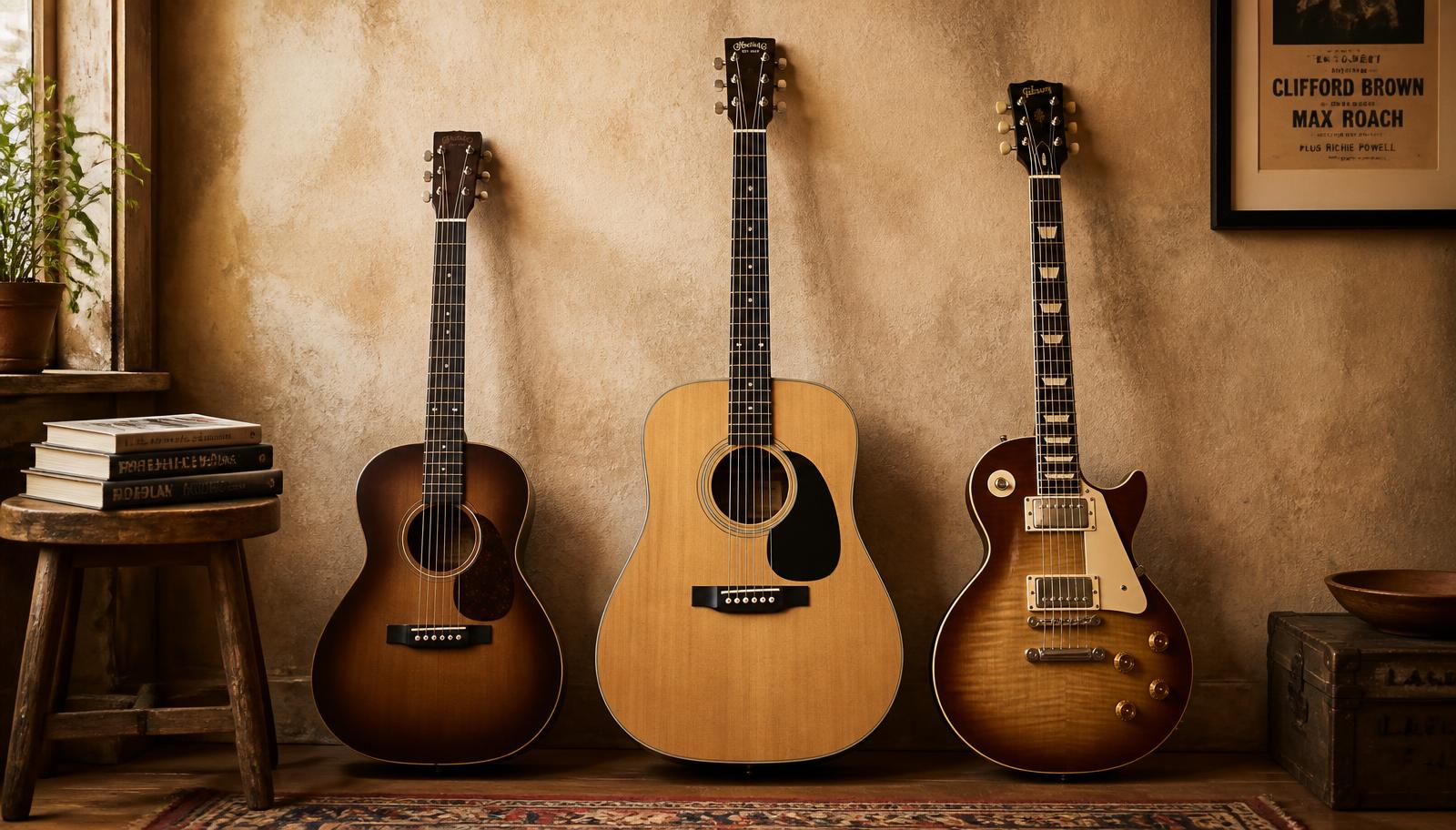
Choosing a Guitar
August 18, 2026 · 7 min read · by Bob Molton
Electric or Acoustic: Which Should You Start On?
Electric or acoustic comes down to one honest test: pick the instrument that produces the sound already living in your head, because that's the one you'll actually pick up on a tired Tuesday night. Everything else — calluses, cost, portability — is secondary to that one fact.
Before you shop
Get the free 7-point buyer's checklist
The exact checks I run on every guitar before I buy it. One page, five minutes, no cost.
No spam, no daily blasts. Unsubscribe any time.
Why does this question cause so much argument?
I get asked this in almost every first lesson, usually with a slightly apologetic tone, like there's a correct answer they're supposed to already know.
There isn't. There's a decades-old myth that you have to "earn" an electric by suffering through steel strings on an acoustic first, the same way some people think you have to learn to drive a stick before you're allowed to drive an automatic.
It's nonsense, and it's cost a lot of people their enthusiasm right at the moment they needed it most.
The guitar world has plenty of real rules. This isn't one of them. So let's throw the myth out and build the decision on things that actually matter.
What sound do you hear when you imagine yourself playing?
Close your eyes for a second and picture yourself a year from now, playing well. What does it sound like?
If you hear a voice and a strummed chord — campfire songs, worship music, singer-songwriter stuff, country — that's an acoustic. The instrument and the goal are the same object, which means every minute of practice feels like progress toward the real thing.
If you hear distortion, a bent string, a solo, a riff with some grit on it, that's an electric. Trying to chase that sound out of a flat-top acoustic is like trying to learn to swim in a bathtub. You can technically do parts of it, but the payoff never quite arrives.
This single question resolves the decision for most people faster than any spec sheet ever will.
Which one is physically easier on your hands?
Electrics win this one plainly. The strings are lighter gauge, the action is typically lower, and the neck is often slimmer, so your fingertips build calluses with less pain along the way.
Acoustic strings are thicker and under more tension, which means more resistance every time you press down. It's not impossible — plenty of ten-year-olds do it fine — but it is objectively a steeper first month.
If sore fingertips have derailed you before, or you have any hand or wrist sensitivity, that tips things toward electric regardless of what music you love. You can always add an acoustic later once your calluses and strength have caught up.
There's no trophy for choosing the harder path here. The only prize is still playing in a year.
What does your living situation allow?
An acoustic is loud by nature — that's the whole design. Great around a campfire, less great at 10pm in a thin-walled apartment with a baby asleep in the next room.
An electric, on the other hand, can be dead silent. Plug into a small modeling amp or an interface, put on headphones, and you can practice at midnight without anyone knowing. That alone has saved more new players' momentum than any technique tip I could give you.
It also matters what you're carrying to lessons, to a friend's house, on a trip. Acoustics need no extra gear. Electrics need an amp and a cable, which is one more thing to remember and one more thing that can fail at the worst moment.
Neither answer is wrong. Just be honest about the actual rooms and routines your guitar life will happen in.
What will it actually cost you to get started?
An acoustic is the simpler purchase: guitar, a gig bag, maybe a tuner and a capo, and you're set. A decent beginner acoustic with a proper setup runs somewhere around $300 to $500 all in.
An electric needs an amp to be useful, and that's where budgets sneak up on people. Plan on the guitar plus a small practice amp — a $100 modeling amp will do more for your tone and your patience than a $50 no-name combo will. Total startup cost lands close to the acoustic, just split across two boxes instead of one.
Neither path is meaningfully cheaper once you add it all up. The difference is in what pieces you're managing, not in the final number on the receipt.
The line item people skip is the setup, and it's the one I'd protect first. Sixty to a hundred dollars spent on action, nut slots and intonation makes a modest guitar feel like it wants to be played, and that feeling is the whole ballgame in month one.
If the budget is tight, buy one tier down on the instrument and keep the setup money. I have never once regretted that trade, and I've watched a lot of people regret the opposite.
How loud is each one in a real house?
An acoustic is as loud as it is. You can play softly, you can stuff a towel behind the strings, but a dreadnought at full strum carries through a wall and down a hallway.
An electric unplugged is quieter than a television, and through headphones it's silent to everyone else in the house. For late-night practice in an apartment or a home with sleeping kids, that's not a small feature — it's the difference between practicing daily and practicing when nobody's home.
I've had students switch to electric purely for this reason and double their practice time in a month. Nothing about their motivation changed. The instrument just stopped requiring permission.
Can you really just switch later if you pick wrong?
Yes, and this is the part people worry about far more than they should. Chords, rhythm, reading tab, ear training — all of that transfers completely between acoustic and electric.
What doesn't transfer instantly is muscle memory around string tension and neck feel, and that adjustment takes maybe two or three weeks, not months. I've watched students move from one to the other and be comfortable again before their next set of strings needed changing.
So the stakes on this decision are lower than they feel in the moment. You're not choosing a lifelong identity. You're choosing what gets you playing this month.
What if you genuinely love both kinds of music?
Then start with whichever one you can afford to set up properly right now, and treat the other as guitar number two, not a simultaneous purchase.
Learning two instruments at once — even similar ones — splits your attention and slows down the early wins that keep beginners motivated. Pick a lane for the first three to six months, get comfortable, and the second guitar will feel like a bonus rather than a burden.
A lot of the players I work with end up owning both within a year or two anyway. There's no rush to get there on day one.
Are there hybrid options worth considering?
There are a few in-between instruments — nylon-string classicals with famously gentle tension, and acoustic-electrics that plug in but still sound and play like an acoustic. Neither one is a true middle ground between electric and acoustic tone, though.
I'd treat those as variations within the acoustic category rather than a genuine third path. If the electric sound is what's pulling you, no acoustic-electric hybrid is going to scratch that itch.
Keep the decision simple: sound you love, hands you have, and rooms you live in. Adding a third category of guitar to compare usually just delays the purchase without improving it.
So what should you actually do this week?
Go somewhere you can hold and hear both — a shop, a friend's living room, doesn't matter which. Play the same simple chord shape on each and notice which one makes you want to keep going.
That gut reaction is more reliable than any list of pros and cons, because it's telling you which sound will pull you back to the instrument on the nights you don't feel like practicing.
If you want it narrowed down further, run your details through the Guitar Matcher and it'll hand you specific models in your budget instead of a general category. And once you've picked, that's exactly where lessons pick up — starting with the instrument you actually have in your hands.
FAQ
Questions people ask me
Keep in touch
One useful guitar email at a time
Join the list and I'll send the free checklist now, plus new tools and posts as they land.
No spam, no daily blasts. Unsubscribe any time.
Keep reading
Where to go next
- Run the Guitar Matcher
Answer a few questions and get specific electric and acoustic models to compare.
- Lessons with Bob
One-to-one lessons that start with whichever guitar you already own.
- Grab the free guide
A no-fluff starting point for brand-new players, whichever guitar you chose.